Sunday, April 10, 2016

New Sport: Book Cart Dancing!

The Summer Olympics are just a few months away, so here is a fun idea... What about adding a sport specific for us librarian athletes out there?! 

Introducing.. Book Cart Dancing!!


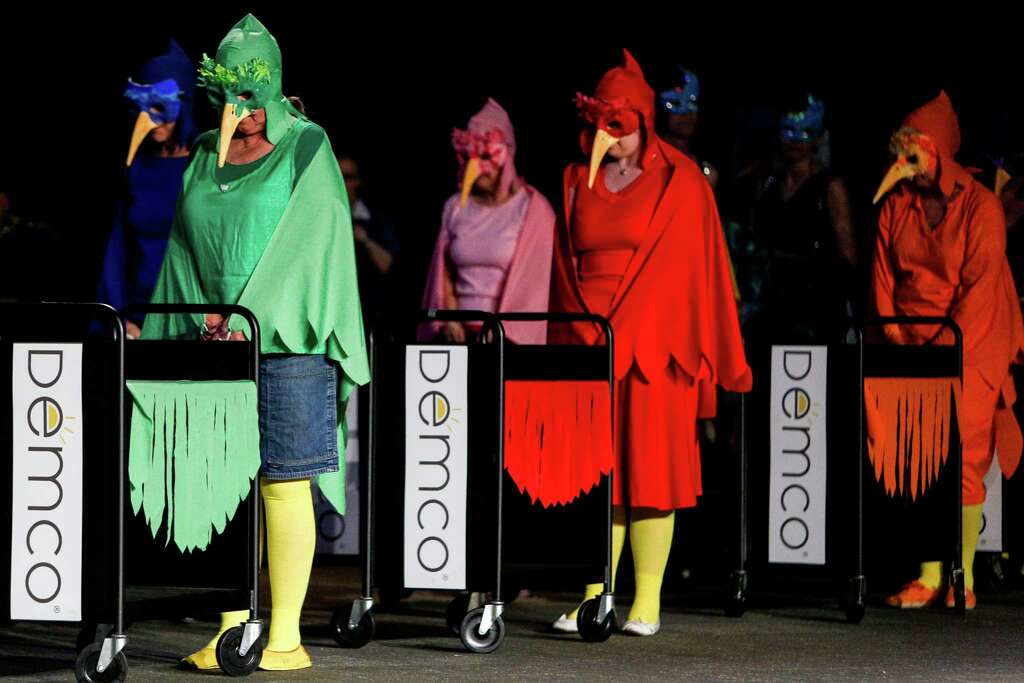
The choreographed routines performed by librarians and graduate students in library science are an actual thing. This activity was popularized in the mid-2000s by Demco, the book-cart manufacturer, which sponsored a world championship competition at the American Library Association’s annual conference for several years.
Why such a craze about book cart dancing? Drill teams promote the library and build morale and teamwork, explains John Ison, who hosted competitions before retiring from Demco.
This fun, interactive library "sport" is indeed harder than it looks. In order to keep all librarians and their associated book carts in sync, you have to have hand signals and other visual cues, or else it looks like a bunch of librarians rolling on carts. 


A signature Gettysburg move as shown in the image above: the pinwheel, in which 10 carts line up, five facing forward and five backward, and pivot around a center point like a propeller. Gettysburg won the bronze cart in the 2010 world championship and is a instant success for all other book cart routine sequences. 
Currently, many graduate programs have adopted these book cart dancing routines into their school's homecoming parades. 
My challenge to all of you reading this, whether you are a librarian or a devoted patron, is to get a book cart dancing team together in your community. It is a guaranteed fun time, both for the participants and for the spectators. So be fun, be creative, and get to dancing!
 Let the games begin!!

Tuesday, April 5, 2016

The Rise and Importance of Bibliotherapy

The statistics about teens and mental illness are staggering.

Below I did a bit of a literature review to learn about some of the research surrounding the positive effects of bibliotherapy on struggling children and teenagers. These same findings shown below can transcend to any age bracket, and further prove the invaluable use of books and character identification. 
  • To my mind, as both a soon-to-be librarian and a writer, the answer is a resounding yes. Fiction has a special magic to it—the ability to weave a world outside reality. To simulate experiences and outcomes. For someone who feels alone, a friend awaits within the pages—someone who says, “Yes, I’ve been there. Have gone through that. Am suffering along with you.”
  • “Bibliotherapy can serve as an unobtrusive, non-threatening medium to help adolescents relieve their stress and increase their coping skills,” write Heidi L. Tussing and Deborah P. Valentine in their 2001 article “Helping Adolescents Cope with the Mental Illness of a Parent through Bibliotherapy,” published in Child and Adolescent Social Work Journal. Tussing and Valentine write: “They (readers) gain insight, on the problem-solving and coping skills of the characters, subsequently applying this learning to their own lives.”
  • Books offering insights into a peer’s condition are also beneficial, says David Rice, children, youth, and family services education coordinator at the Ch.O.I.C.E (Changing Our Ideas Concerning Education) Academy, an integrated transitional mental health facility and education center in Vermont. Rice cites an experience he had when his students read Anything But Typical by Nora Raleigh Baskin, a novel about a character who has Asperger’s syndrome. “Only one of the boys in class had Asperger’s, but the most profound aspect of the experience was what the other students learned about how his mind works, and how he corroborated with his peers what the character was feeling,” Rice says.


Bibliotherapeutic books can be fun and enjoyable, and do not have to be stigmatized as solely "bibliotherapy." Find below some great recommendations on the Carnegie website on a wide variety of physical, mental, and emotional issues that readers can relate to characters about such as:
  • Divorce
  • HIV/AIDS
  • Death
  • Physical Disabilities
  • Anxiety
  • Depression
  • Bullying
  • Weight
  • ADHD
  • Moving
The list could go on longer. My recommendation for this week is for each of you readers to find a book that you could use as bibliotherapy in your own lives. Whatever the issue is, finding solace in a book can often be the best medicine. 


Saturday, April 2, 2016

Twitter and the Library

Social media is all of the craze lately, with patrons of all age ranges being obsessed with it. Often times, the library tends to shy away from social media, considering it an evil doer, and steering patrons away from library services only to dive more onto their smart phone screens. However, social media is not all that bad. Below are some ways that the library can use the Twitter platform in order to reach out to more patrons.


Report library happenings

If the library is closing early due to weather or if a printer is down, librarians can communicate via Twitter. If we are having events like an international photo contest or a chili cook off, we can let people know. It’s also helpful to let people know when new displays, art, or exhibits are put up. Posting an update every time libraries put up new book displays for the month as well as posting a picture of a particularly interesting cover can entice patrons who otherwise would not have come into the library in the first place.

Promote library resources/services
When libraries get new interesting resources, librarians can let people know via Twitter.  Libraries can also simply promote print collections at relevant times. For example, a tweet promoting Oscar Wilde’s short fiction could lead students to come up from the stacks with a James Joyce title due to being inspired by the library’s Twitter post.

Engage Users

 Twitter can be an active attempt to engage members of the community. Posting news articles of relevance and ask questions allows users to feel that their voice matters, and gets them thinking about the posts. 

Solicit feedback

Twitter is a perfect tool to ask for feedback on some service libraries are thinking about adding or some initiative the library recently implemented. Twitter is great for informally asking questions. When designing resources or services for users, it’s important to actually ask them. Twitter is one tool that could facilitate that. 

Create greater awareness of the library

Doing all the aforementioned things creates a greater awareness of the library and what it has to offer. Being active on social networking sites like Twitter makes the library more visible. Not every post gets noticed. And some that you think go unnoticed are actually effective. 
Facebook, email, and print are all important too and should be used accordingly depending on your community. But Twitter is great tool to have in your communication toolbox. It can be powerful in furthering your library’s mission due to its short and effective means of communication.